• Unknown's avatar
    He's been called the Pied Piper of the Second Running Boom. Once an overweight couch potato with a glut of bad habits, including smoking and drinking, at the age of 43 Bingham looked mid-life in the face—and started running.

  • Enter your email address to subscribe to this blog and receive notifications of new posts by email.

    Join 557 other subscribers
  • PC Blog Archives

Flashback Friday: Happy Trails

With all the emphasis on off-road running and racing, I thought it would be fun to revisit my discovery of trail running.

Venturing off-road leads to simple yet profound discoveries.

I’ve never been much of a trail runner. Okay, I’ve never been much of a road runner either, but that’s not the point. As one whose feet never get more than an inch off the ground, I worry about bumps in the sidewalk. So it’s hard to imagine encountering branches, roots and rocks.

But I finally gave alaskatrail1in. With all the hoopla about the pleasures of trail running, I thought I should at least see what the fuss was about. And to my surprise, I discovered a fun, new running environment.
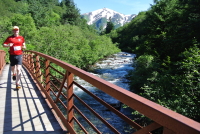
It didn’t hurt that the first trails I tried were in Eugene, Oregon, where the paths have names like “Amazon” and “Pre.” It wasn’t hard to figure out what people liked about running on them. These bark-covered, well-kept, well-marked routes were ideal for my first tentative off-road ventures.

It also didn’t hurt that the next trails I tried were around Lake Tahoe, California, where physical efforts are rewarded with spectacular panoramas. This terrain wasn’t nearly as predictable, however. Sometimes it seemed I was dodging as much of the trail as I was using. Nevertheless, the joys of off-road running were beginning to take hold.

Somewhere out on these paths, I felt a change taking place. I found that my flat-footed, stubby-legged stride, which looks so awkward on the street, actually worked to my advantage on the trail. My low-to-the-ground build also made me more stable. On this rugged ground, where even the fast move slowly, I was able to keep up.

Then there was the inescapable romance of running through the woods.

Without knowing it, I was becoming just one more animal in the forest. As I ran, I wasn’t always sure what I was seeing or hearing, but I felt more connected to the squirrels and birds and whatever else was hiding in the brush.

There was a certain giddiness to the experience. The irregularity of the terrain masked the irregularities of my running. And walking the steep uphill sections was not merely accepted but advised. The more I ran, the better I felt. And the better I felt, the more I understood.

Life is simpler on the trails. Running here can bring you closer to what running was meant to be. Running doesn’t need to be only about going alaskatrail2farther and faster. It can be about feeling free and unfettered. Running can be about opening yourself up to people, and it can be about opening yourself up to your surroundings.
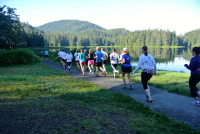
It’s not that we can’t benefit from running on the pavement or on the track. We can learn a lot from logging dozens of miles or hammering through repeats. But these lessons are learned as much with our will and fortitude as they are with our legs and lungs.

On the trails, however, away from the more obvious measures of skill and the tangible signs of what we’ve gained or lost, we can learn with our eyes, ears and hearts. And some discoveries can be rather humbling. In this rugged environment, we may find that, as part of the animal world, even the finest of us aren’t very well suited to deal with nature. Despite all of our human sophistication and intellect, even a half-witted chipmunk can outsmart us in the wilderness.

Trail running has added another dimension to my experience as a runner. While I’m not prepared to give up the comfort of water fountains, mile markers and smooth roads every day, I now believe that for me to be complete as a runner, I need to spend more time finding the forest through the trees.

Waddle on, friends.

Back to The Penguin Chronicles Archive

Worst Parade Ever

925_1 Of all the signs I’ve seen while running marathons and half marathons my favorite has to be “Worst Parade Ever.” That just seems to sum up what it must look like to someone standing on the sidelines watching thousands of people – young, old, tall, short, thin, not-so-thin – running and walking for hours on end. Even if you’re waiting for a friend or love one to pass by it has to be mind-numbing to see so many people pounding the pavement.

One of my favorite signs, which I saw many years ago at the Portland [OR] Marathon was “GO GAMMY GO.” My guess is that the young girl that was holding that sign is probably a runner herself by now. After all, if Gammy can run a marathon then she was almost certainly inspired to do one herself.

Of course, we’ve all heard the never helpful “You’re almost there.” This is especially not helpful at, say, mile 15 of a marathon. And then there’s the almost always incorrect “You’re looking good.” I’m not being critical. I know that people are just trying to be nice.

Once, at about the 6K mark of an 8K along the Chicago lakefront, a passer-by yelled out to me “PICK IT UP.” What they didn’t know, and couldn’t have known was that I WAS picking it up. I had already begun my blistering finishing kick. It’s just that when picking it up means going from a 12 minute pace to an 11:45 pace it may not be all that obvious.

Races look very different when you’re on the course. What may seem to the casual observer as an unhurried jog may be – in fact – a dual to the death. I’ve spent miles with a laser focus on a person in lime-green shorts because I absolutely did not want to look at those shorts anymore. Passing them became the single most important thing in my life.

925_2As a run/walker I’ve often been in a leap-frog battle with someone who insists on “running” the whole way – even if their running is mostly just moving their arms in a running motion while they walk. I’ll pass them when i run. They’ll pass me when I walk. And this can go on for miles until i either move far enough ahead during a run interval that they don’t catch me or THEY move far enough ahead during my walk interval that I don’t catch them.

Either way, I sure that anyone watching us go past would have no idea what was going on. And that’s OK. In the long run – pun intended – what matters most is what’s happening between and among those of us on the course, whether that’s an elaborate winning strategy or simply trying to get past the guy wearing the lobster hat.

Once we cross the start line we are in our own world. What matters most is – for many of us – what matters least. We know that once we cross the finish line we will have to go back to our real responsibilities: as husbands, fathers, employees, students, or one of a hundred other identities that we have. When we cross the finish line we go back to being who we are.

But out on the course we are who we want to be. We are heroes. and champions, and warriors. We are strong. We are prepared. We are ready to battle the course, the day, the runners around us, and ourselves.

They may be the worst parades ever, but there’s no place in the world I’d rather be.

Waddle on, friends.

John

Special Report: Why JBR never hired elite runners

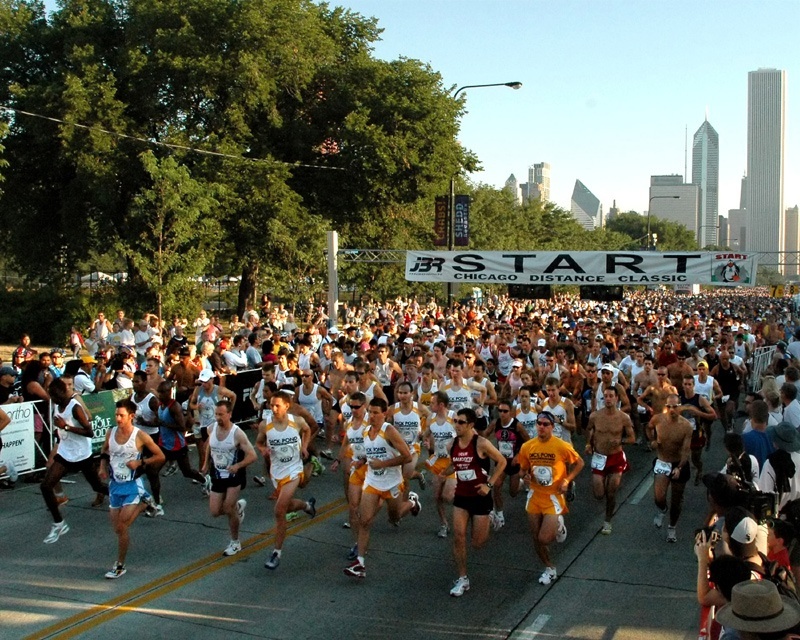
CDCSTARTIn 2002, with nothing more than audacity and hope, David Babner and I created John Bingham Racing [JBR] and purchased the Chicago Distance Classic. We went on to create the Capital City Half Marathon [Columbus, Ohio] and the Arizona Distance Classic in Oro Valley, Arizona – just outside of Tucson. We also had a few smaller races in Columbus.

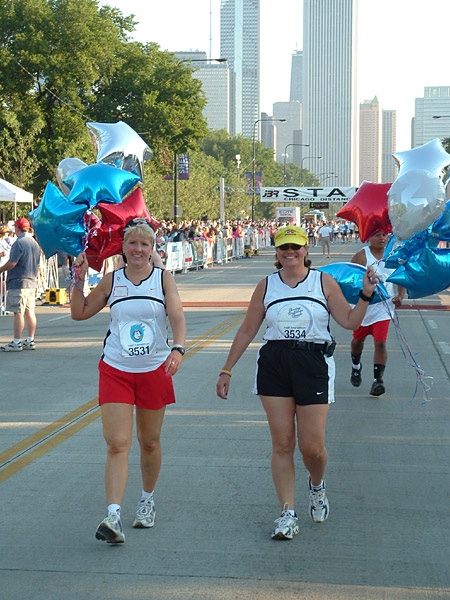
We had only one corporate philosophy: treat everyone’s accomplishment as meaningful to them. Not to US, not to OTHERS, but to THEM. And being a back-of-the-packer who has finished last – or nearly last – in races I vowed that no one in the pack would be humiliated. To that end, we had volunteers – the “Balloon Cuties” – who walked behind the final finisher. It was impossible to finish last in a JBR event.

I’m a Chicago kid. The race was a Chicago running tradition. It’s the oldest continuously held race in the city limits. What I wanted, what WE wanted, was an event that celebrated the Chicago running community. We wanted a race that honored the achievement of Chicago’s best runners, provided a vehicle for local charities to raise money, and helped the entire Chicago community at large celebrate an active lifestyle.

The best runners in any community know each other. In many cases they’ve been racing against each other since high school or before. We wanted the BEST runners in OUR community to race against each other. We did NOT want OUR best runners to finish 11th because we hired 10 elites to finish in front of them.

How can it possibly be motivating to think that the BEST you can hope to do is finish 11th? We wanted OUR runners to win and build their confidence and running resume’s. We wanted the man or woman who came in 3rd one year to know that they could come back and take a shot at winning the next year. It was OUR race. OUR running community.

cutiesWe handed out free entries to the running specialty stores because we knew that many of their employees wanted to compete. We gave free entries to private running coaches to encourage them to bring out the best in their stables. We didn’t PAY anyone to race, but, we went out of our way to make sure that anyone who wanted to race at the front could toe the line.

Who made that possible? Not just JBR. It was made possible by the thousands of runners and walkers who paid their entry fee.

What we tried to do, and what I think we successfully did, was provide an opportunity for everyone to take the risk of finding out what their best was on race day. For some it was finishing in a little over an hour. For others it was finishing in a little over 4 hours.

I’m proud of what we accomplished with the Chicago Distance Classic. We went from 2,400 registrants to over 10.000 in the years we produced the race. When Competitor Group bought the race and changed the name to “Rock ‘n’ Roll Chicago” I was happy for the running community. A small group of part-time employees can only do so much. What CGI did very well was take a good local race and make it a destination event.

There was nothing sinister about our decision not to hire elites. It wasn’t about money. It wasn’t about not supporting elite runners. The decision was TO support the running community to which we all belonged.

John

FLashback Friday: My Hero. Bob Dolphin

What’s even MORE amazing is that I want back to celebrate Bob’s 500th in 2012.

The transformative powers of running apply at any age.

bobdolphinLast April, I went to the Yakima River Canyon Marathon, a point-to-point race from Ellensburg to Selah, Washington. I was there to help 77-year-old Bob Dolphin celebrate the completion of his 400th marathon.

You read that right. A 77-year-old doing his 400th marathon, with Yakima being the 24th marathon Bob had run in the past 12 months. Perhaps even more amazing is that Bob didn’t run his first marathon until he was in his mid-50s.

Joining me in the celebration were members of the 50 States and DC Marathon Club, the 100-Marathon Club, the Marathon Maniacs, and Bob’s local running friends from the Hard Core Runners Club – clearly not your average group of midpackers. To put this particular gathering into perspective, at one table at the pasta party there were six men who had run a combined total of almost 2,000 marathons. You read that right, too. One table. Six men. Nearly 2,000 marathons.

Even though I’ve run 30 to 40 marathons, I didn’t really fit in with the celebrants. And these folks don’t just run marathons either. As often as not, they hit the lap button on their watches at 26.2 miles and continue on to complete 50-, 60-, or 100-mile distances – every few weeks. No, these men and women are at the far edges of our sport. And they all came to honor Bob for the way he’s lived his life both on and off the roads.

A high school dropout turned Marine officer, Bob has never let age or hardship deter him from anything. The same week his daughter graduated from high school, Bob received his college diploma after years of part-time study while working and raising his family. Still eager to learn, Bob ultimately earned a Ph.D. in entomology.

As with his studies, Bob couldn’t get enough of running once he got started. Like many adult-onset athletes, he initially viewed running simply as something to try. But then he found he could continue to redefine himself through running. For Bob, and I’d bet for many of his multimarathoning compatriots as well, every mile answered questions about courage, strength, hopes, and limits, but others remained that could only be answered with another mile, and ultimately, another marathon. Even with 399 marathons under his belt, Bob still had more answers to run down.

This became clear when I asked Bob if he thought he’d take some time off to savor his 400th marathon. “No,” he said. “I’ll probably run number 401 next weekend.” He went on to explain that he was hoping to run about 20 marathons per year so that he could run his 500th on this course again in 2012.

If he does, I hope I’m there. I hope I’m there to see him run into the arms of his wife, Lenore (who’s been at the finish line of every one of Bob’s races). And if I am, I’ll know full well that 500, like 400, will be a milepost, not a destination.

Waddle on, Bob.

Back to The Penguin Chronicles Archive

Race Relations

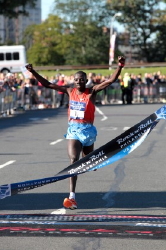
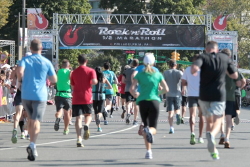
Biwott_StanleyFV-Philly13-280x421Defending champion Stanley Biwott of Kenya owned the streets of Philadelphia once again on Sunday morning, winning the Rock ‘n’ Roll Philadelphia Half Marathon for the second-straight year in 59 minutes and 36 seconds. The 27-year-old Kenyan ran the fastest half-marathon time on a record-eligible course in the U.S. this year. I didn’t get to see him finish because it took 45 minutes to get the other 22,000 participants across the start line. By the time I walked to the finish line, it was over.

And that’s kinda the point. It’s hard to make a connection with the winner of a race if you’re barely at mile 1 when they break the tape.

In a recent blog [Dumbing Down] Toni Reavis, a well-respected member of the running community, quoted long time sports agent Brendan Reilly, and another well-respected member of the running community, as saying:

“I think we’ve had too many years of the John Bingham (Waddle On, Penguins) philosophy.  John is a nice guy, a very entertaining and eloquent speaker, but there seems to be little in the sport these days to carry the runners that John has gotten off the couch to the next level of aiming to run faster and treat our events like RACES. And without that mentality, it is no wonder so few participants really care of even understand that somebody just ran 4:45 or 5:20 pace to win their race.

It’s true that I couldn’t run a 4:45 pace even if I was dropped from a plane. It just isn’t in me. On the other hand, I’m pretty sure that Stanley Biwott couldn’t play bass trombone with the National Symphony in a performance of the Berlioz Requiem as I did. It just isn’t him. I don’t think that means he doesn’t care or understand the talent and dedication required in my profession any more than I don’t care or understand the talent and dedication required in his. It’s just different.

I would also argue that some, if not most, of the folks that have gotten off the couch have, indeed, tried to go to the next level of aiming to run faster. I can’t remember a conversation at any of the clinics or seminars that I’ve given or moderated in which people asked how they could run more slowly than they were. No one asked what to do to finish a marathon in over 5 hours if their marathon best was 4 hours. It’s in our nature, as runners, to want the best of ourselves. It’s just that the BEST is not going to be THE best.

FinishArea-Philly13-631x421So what do we do? What do we do as individuals? What do we do as a community? What do we do as an industry? Here’s what I think. We have to take a page from the NASCAR handbook. We have to find a way to make the BEST in our sport also the most approachable and popular in our sport. It can be done.

When elite runners like Josh Cox or Deena Kastor or Kara Goucher appear at the race expos they pack the house. Why? Because they connect directly with the REST of the participants. The hundreds of people who stand in line to get autographs and have their photo take with these elites runners DO care and understand what it takes. They also care and understand that Josh and Deena and Kara are more than just elite runners. They are spouses and parents and have interesting lives, that they’re willing to share, when they are NOT racing.

I was there to shake the hand of the final finisher on Sunday. Stanley was not. I get emails and Facebook messages thanking me for being there. Stanley does not. But he could.

My advice to ALL the elites out there [and ALL of their managers]. The next time you win a race, bring a change of clothes. Get cleaned up after the awards ceremony and join me at the finish line. I think you will see that these people CAN care and WILL care if you share your success with them and allow THEM to share their success with YOU.

Waddle on, friends.

John

Flashback Friday: Running the Bases

The Penguin Chronicles :: May 1995 :: Running the Bases

On my way to the pool one evening, I noticed a young boy, maybe 10 or 11 years old, standing alone at home plate in an empty baseball field. His actions struck me as curious and I found myself so fascinated that I just sat in my car and watched.

He was standing at home plate swinging his arms around wildly. Suddenly, without warning, he bolted towards first base. As he rounded first base, he threw his arms up and ran around the bases waving his fists above his head. At that moment, I knew what had happened. He had hit the winning home run and was running the bases.

His joy was the joy that many of us feel every time we put on our running shoes. It is a joy that is rooted not in PRs but resides deep in our imaginations. Those of you at the front may be doers, and I applaud your accomplishments. But from the mid-pack back, we are dreamers living out a fantasy that is no less real than the fantasy of the boy in the ball park.

I know, as I approach that point in a race where doubt creeps into my mind, that I am running with unrivaled grace. Or at least I think I know. I worked the water table at a recent local 5K and watched with amazement as friends that I knew had been ahead of me the week before PLODDED past. How can this be, I wondered? How is it that I am so fluid and graceful [in my mind] and yet my Penguin colleagues look so ponderous?

My answer may be your answer. I am running in my childhood dream. I am running unfettered by my past indiscretions with food and smoke and people. For the 20 or 30 or 60 minutes a day that I am running, I am a runner. I am skilled and competent. I am relaxed and self-assured. I am all that I ever wanted to be. I am all that I am not when I’m not running.

The lesson I learned, again, from this boy was that it is important to put action into your dreams. It wasn’t enough for him to hit the winning home run in his mind. He needed his body to experience the real sensation of running the bases. It wasn’t until I began to put action into my dream of being fitter, and healthier, and leaner that my body finally got the message. I had often hit the home run of dieting success or saving money or being better in my relationships, but I rarely ran the bases.

I am often asked by well meaning non-runners and some not so kind eagles and sparrows if I get bored running as slowly as I do. My answer is always: NO! How can I be bored when I’m leading the Boston Marathon? How can I be bored when I am locked in mortal combat with the memory of a mean spirited elementary P.E. teacher? How can I be bored when I am running down that junior high bully? After a lifetime of running from, how can I be bored running to??

Not long ago, in the middle of a 5K, I yelled to a corner worker, “Hey, seen any fast runners come by here yet?” He looked at me, and without hesitation said, “Nope, you’re the first one!” I don’t know who that man was, but I know that in his heart he is a Penguin. He knew that for me, as for so many others, the real race is in our imaginations. And he knew, that what was most important was that I was running the bases.

Waddle on, friends.

The Little Book That Could

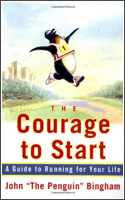
book_the_courage_to_startI am living proof that your life can change with a single phone call. We all know that our life can change for the worse with a single phone call, but we don’t often think that the most dramatic, and positive, change in your life can start by saying “Hello”. It did for me.

In the Fall of 1995, then editor of Runner’s World Magazine, Amby Burfoot called me in my office as Chair of the Department of Music at Middle Tennessee State University. Marlene Cimons had sent him a few emails that I had sent to the then secret email group “The Dead Runners Society.” Keep in mind that this is 1995. No Facebook or Twitter. He asked me if I’d like to write 8 monthly columns for Runner’s World beginning with May 1996. Without thinking, I said yes.

In the Spring of 1997 I found myself being carted around New York City by Linda Rogaar, a book agent. Through a mutual friend, Sue Flaster, she had connections with some of the biggest publishing houses. The next thing I know, Simon and Schuster, through their Fireside division, is making me an offer to write a book. That book, which they wanted to call “Slow But Steady Wins the Race” became “The Courage to Start.”

Writing that book was the most terrifying experience of my life. The only other thing I’d written was my doctoral dissertation “The Innovative Uses of the Trombone in Selected Compositions of Vinko Globokar” copies of which are available for terminal insomniacs. The writing took months of sitting and staring at a laptop screen hoping that words would magically appear. When they did, I wrote with manic intensity for fear that the flow of words would stop.

I submitted the manuscript to a young editor who only managed to get through the first half before she got married and left. The second editor got through the second half, and then she quit. The third editor shipped the completed manuscipt – the ONLY copy because everything was done on paper in those days – to the wrong address and it took weeks to find it before she quit. And the fourth editor, the one whose job it would be to promote the book had no stake or interest in the project and the book sort of died on the vine.

But, because of you, the readers, the little book started selling. Not “Harry Potter” numbers, but it was selling. Running titles are a niche’ market, and this book didn’t exactly fit into the “read this and get faster” genre. It was part confessional, part life philosophy, part new age psychology, part idle musing. It didn’t fit neatly into any category. In fact, if you look at the cover it’s cataloged as “Self-Help – Motivational”, not running.

This week I heard from Linda Roghaar that this little book that no one seemed to want has sold over 65,000 copies. 65,000. That’s a big threshold to cross. It means that Simon and Schuster now wants to release an “e” version. It means that they think it will continue to tell both in print and digital formats. In means that it won’t go out of print any time soon.

This is a thank you note; to those of you who have bought the book, to those of you who have passed it on to friends, to those of you who keep tattered version in your nightstand, to those of you who have – and continue – to find inspiration in what we believed was simply a story about a middle-aged over-weight, smoker, drinker, over-eater who changed his life with his own two feet.

Thank you. Thank you. Thank you.

Read on, friends.

You can find the print version on Amazon or get an autographed version at: Courage to Start

Flashback Friday: White Line Fever

Since I’ve spent so much time riding in the past couple of weeks, this old column has been on my mind.

Believe it or not, the human machine can equal the power of a Harley.

Until I discovered running, I had only two passions in life: music and motorcycles. Each fueled the other, and employment in one usually meant greater opportunities to pursue the other.

For many years, this combination was perfect – I worked long enough as a freelance musician to build a financial base, then rode long enough to need the next gig.

Maintaining the balance between time and money was tricky, but with care and a willingness to consume nothing more than peanut butter and beer, it was possible.

Most of my friewith jimnds didn’t understand my consuming passion for motorcycles. It wasn’t my love of bikes that astounded them; it was my intense need to ride. As I tried to explain to them, riding wasn’t about transportation. For me, riding was about transformation. Watching the world pass beneath my feet stirred my spirit. The blur of the broken white line that ran down the center of the old U.S. highways was completely hypnotic. A classic (and terminal) case of “white line fever.”

Then one day I discovered that same feeling, the same sense of moving over and through the world, the instant I laced on a pair of running shoes and felt the asphalt under my feet. I had no idea that moving slowly across the ground would feel as satisfying as moving fast on a bike. But it did. The motion, not the rate of speed, was what felt so good.

This must be why I can’t remember ever having a bad ride – or a bad run. As a runner and a biker, I’ve been hotter, colder, wetter, and more tired than I’ve ever wanted to be. I’ve been ready to stop hours before I could. I’ve ridden roads and run courses that I swear I’ll never travel again. But none of these times were bad.

I’m not really sure how they could be bad. I suppose if comfort is your sole criterion for happiness, then being soaked to the skin and knowing you still have 200 miles to ride or 10 miles to run would be bad. If being so cold you can barely grip the handlebars or so hot you can feel your brain turning to soufflé makes you unhappy, then you may have had some bad rides or runs. But not me.

Countless stories testify to the limitless physical reserves of the human body. Men and women routinely endure hardships that make the most difficult run seem like a walk in the pjust gsark.

As runners, we have the extraordinary capacity to detach ourselves from the discomfort we feel. At extreme levels, this can almost become schizophrenic: We tell ourselves that we should stop what we’re doing, yet we continue to enjoy every minute of it.

But running is certainly not all about extremes. Somewhere between those runs that tax our reserves and those that are simply too easy are the countless runs that are just right. These are the runs when we’ve read our bodies and spirits accurately, and have found the place where we can simply go along for the ride. It’s in that place where we catch the fever. And, take it from me: Once you’ve caught the fever, and felt the heat of that passion, there is no cure.

I’m not sure exactly when liking to run became longing to run, when wanting to run became needing to run. I only know that, as there once were roads that had to be ridden, there are now roads and trails and courses that must be run. There are miles and moments and memories that only converge when the shoe strikes the ground. And, in that white-hot instant, the world makes sense.

Waddle on, friends.

Back to The Penguin Chronicles Archive

The Longest Day

Sometimes we set goals well in advance. We plan for months, or even years. We carefully consider all the requirements to be successful; equipment, training, travel, and support.

Sometimes a goal jumps up and bites us. Yesterday, I was bit.

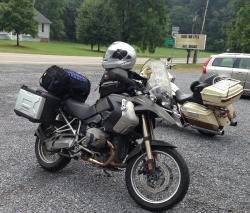
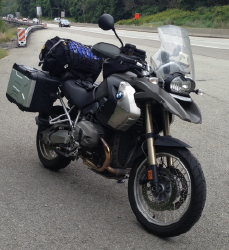
I’ve spent the better part of that past two weeks on the road. I visited with family, spent time with friends, and worked the RnR VA Beach event. Everything I needed for all of that was packed on a BMW R1200GS. It was my transportation, my office, and my companion.

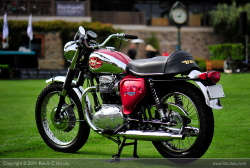
You don’t have bsauseto know much about me to know that motorcycling has been a life-long passion. From the time I rode a Sears Moped, at 11 or 12 years old, I have been in love with the magic and the motion of motorcycles. The fact that the “older boy neighbor” across the street had a BSA Lighting and wore a leather jacket just made the desire to ride even stronger.

I suppose the “penguin” philosophy started with motorcycling. I didn’t care how far I rode. I didn’t care how fast. And I never cared very much what I was riding. I liked riding big bikes and small bikes. I liked riding on the street and off-road. If it had a motor and two wheels [sometimes three] I wanted to be on it.

But it was being “on the road” that always had the greatest appeal. Maybe it’s just wanderlust, or an insatiable curiosity, I don’t know. What I know is that traveling the highways is where I felt most at home.

A big day for me would be 300 miles or so. That’s about 8 hours in the saddle and that seems about right. Twice in my life, once when Jenny and I did the 1000 miles in 24 hours “Saddle Sore” challenge, and once when my old riding and Army buddy Larry and I decided to ride from Arlington to Chicago, I’ve ridden over 700 miles in a day.

Yesterday’s ride was just a little over 700 miles. And, it was the longest solo day I’ve ever ridden.

I didn’t plan to ride that far, it just happened. They day was nearly perfect, the traffic wjust gsas light, the bike was running well, and I was feeling good. The miles kept adding up. I’d get gas, ride a 125 miles or so, get gas, and do it again. Before I knew it, I was almost to Indiana. At that point, stopping wasn’t an option.

So often, as a runner, I limited myself to what I thought I could do. When I thought that a 5K was a far as I could run I ran a lot of 5K’s. Then it was 10K’s. The half marathons. The fulls. At each new distance I defined the limit of far it was that I could go.

I look back now I think how wrong I was. I look ahead and wonder whether I am still setting limits based on imaginary limitations. To paraphrase Satchel Paige, I wonder how far I could go if I didn’t know how far it was.

It may be too early to start setting goals for 2014, but I’m beginning to think I’m going to have to find out how far too far really is.

Waddle on, friends.

Miles to Go

Here is an early Penguin Chronicle that may help to put the whole “Penguin phenomenon” into perspective. As you can tell from the tone of the column, no one was more surprised by how this started than me.

From time to time I get insights into how my life is changing – and how running has become the change agent. Those of you who, by nature or by training, are better tuned to your own psyches may scoff at the density of my awareness. Be reminded that I have been no more inclined to be open with myself than I have with others.

It’s also helpful to remember that I’ve had a difficult time thinking of myself as a runner. It doesn’t seem to matter what my log says or what others say, I am still more comfortable referring to myself as “someone who runs” than as “a runner”.

Lately I’ve noticed that in stressful times I reach for my running shoes. Earlier in my life I might have reached for a cigarette, a beer, some food or the company of another person. And, when I once would have turned outside myself for help in tough times, running now allows me to turn inside.

I’ve noticed, too, that in times of celebration and joy – when before I would have reached for something to eat or drink – I now reach for my running shoes. I find myself running when I’m happy as well as when I’m troubled.

Through the activity of running, more than the sport itself, I have come to be a much better friend to myself. Through running I have learned to console myself, congratulate myself and be accepting of myself.

There are times in my life, though, when there are not enough miles to run. There are times when the movement of my feet seems like the only measure of control I have over my day or my life. On those days – on the days when circumstances conspire to show me only the worst of who I am and who I am becoming – my running shoes become life-preservers.

At times I find myself sitting and staring at my shoes, waiting for them to somehow find the energy to begin running by themselves. It’s almost as if, like a squirrel, I have been hiding good feelings inside my shoes for the days when I need them.

The miracle is that very often the strategy seems to work. With the first tentative foot strike, the first stumbling step, the first stride of conviction toward the person I want to be, I am liberated. As the miles pass I stop staring at the ground in defeat. I begin to hold my head up. I rediscover pride in overcoming the past and conquering the present.

In those moments I come closest to accepting that I am a runner. During those minutes and hours I am sure of one thing – I can put one foot in front of the other. I truly am a runner and not just a person who runs.

And in those moments I realize I am also part of a community of runners. Even when I am running alone, I know that somewhere, at the same time, hundreds of other people are doing the same thing. Some, perhaps, for the same reasons.

The best part is knowing that some of you out there are running with me.

Waddle on, friends. I need the company.

Back to The Penguin Chronicles Archive